

Key Takeaways
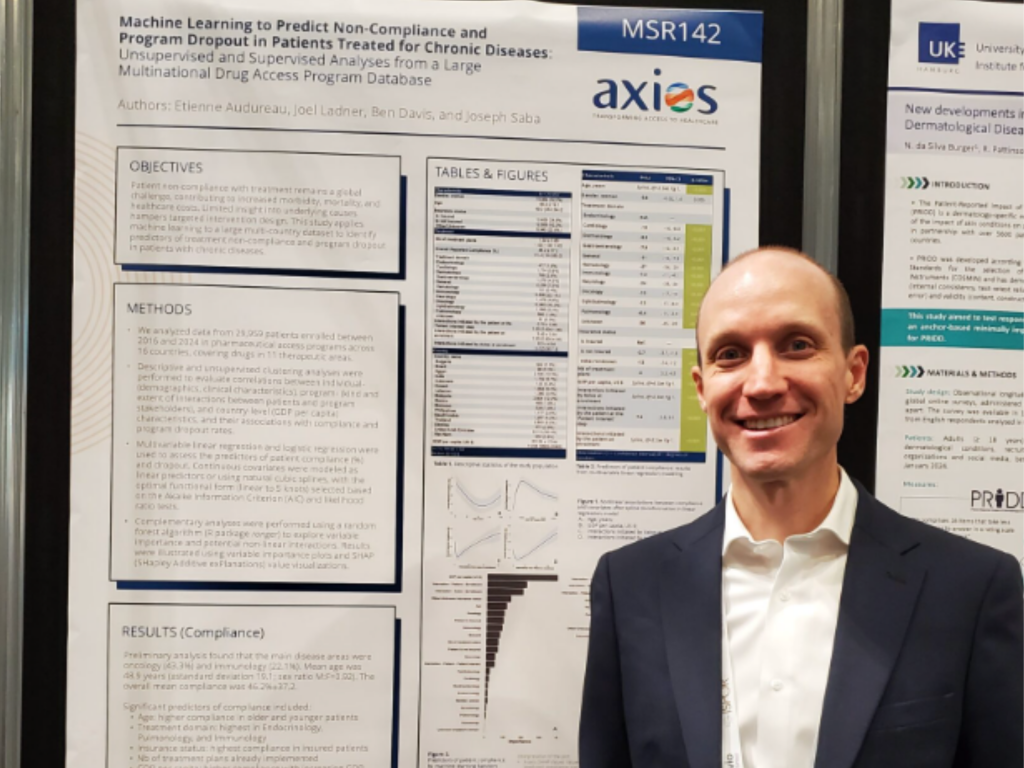
At ISPOR Europe 2025, Axios International presented research exploring how machine learning can help predict treatment non-compliance and program dropout. Analysis of access program data from nearly 30,000 patients across 16 countries and 11 therapeutic areas identified patterns linking patient engagement, health system context, and program design to treatment outcomes.
Machine learning can reveal patterns in dropout risk: Patient engagement and other program data can help identify factors associated with treatment discontinuation.
Treatment outcomes are shaped by context: Health system and program factors can influence whether patients remain engaged with treatment.
Prediction can support earlier intervention: Identifying potential risk earlier may help programs provide more targeted patient support.
Taking a Closer Look at Treatment Dropout
At ISPOR Europe 2025 in Glasgow, Scotland, Axios International presented a poster examining how machine learning can help predict and address treatment non-compliance and program dropout in chronic disease management.
The research reflects a question that is increasingly important for patient access programs: Can we identify the factors associated with treatment dropout early enough to do something about them?
For patients with chronic conditions, starting treatment is only one part of the access journey. Staying on treatment over time can be affected by a wide range of factors, from patient engagement and treatment-related considerations to healthcare system barriers and the way an access program is designed.
Understanding these factors can help shift the focus from responding to dropout after it happens toward identifying potential risks earlier.
What the Data Revealed
To explore these relationships, the research team analyzed access program data from nearly 30,000 patients across 16 countries, covering medicines in 11 therapeutic areas.
The breadth of the dataset made it possible to look beyond individual programs and examine patterns across different patient populations, healthcare environments, and program structures.
The analysis identified relationships between treatment outcomes and several dimensions of the patient experience, including patient engagement, characteristics of the health system, and aspects of program design.
These findings reinforce an important principle in adherence research: there is rarely a single explanation for why patients discontinue treatment. The factors associated with dropout can differ across populations and settings, making context an important part of understanding treatment behavior.
From Identifying Risk to Supporting Patients
The potential value of machine learning lies in what it can make possible after these patterns have been identified.
By analyzing large volumes of program data, predictive models may help identify patients or situations associated with a higher likelihood of treatment discontinuation. This can create an opportunity for programs to consider additional support before a patient disengages.
Importantly, prediction is not the same as explanation. A model can identify patterns associated with risk, but it cannot fully capture the individual circumstances behind a patient’s decision to continue or stop treatment.
The most useful application of predictive analytics therefore comes from combining data-driven insights with an understanding of the patient and their environment. Depending on the barrier, that could inform more targeted education, follow-up, treatment navigation, financial support, or other interventions.
What Machine Learning Could Mean for Patient Access
Access programs generate valuable real-world data every day. The opportunity is to use that data not only to measure what happened, but to learn more about why it happened and where there may be opportunities to improve.
Machine learning can help identify relationships across patient, program, and health system factors that might otherwise be difficult to see at scale. Used thoughtfully, those insights could support more proactive approaches to adherence and help programs respond to patients’ needs earlier.
The research presented at ISPOR Europe 2025 points toward a broader opportunity for patient access: using real-world data and advanced analytics to make support more targeted, responsive, and informed by evidence.