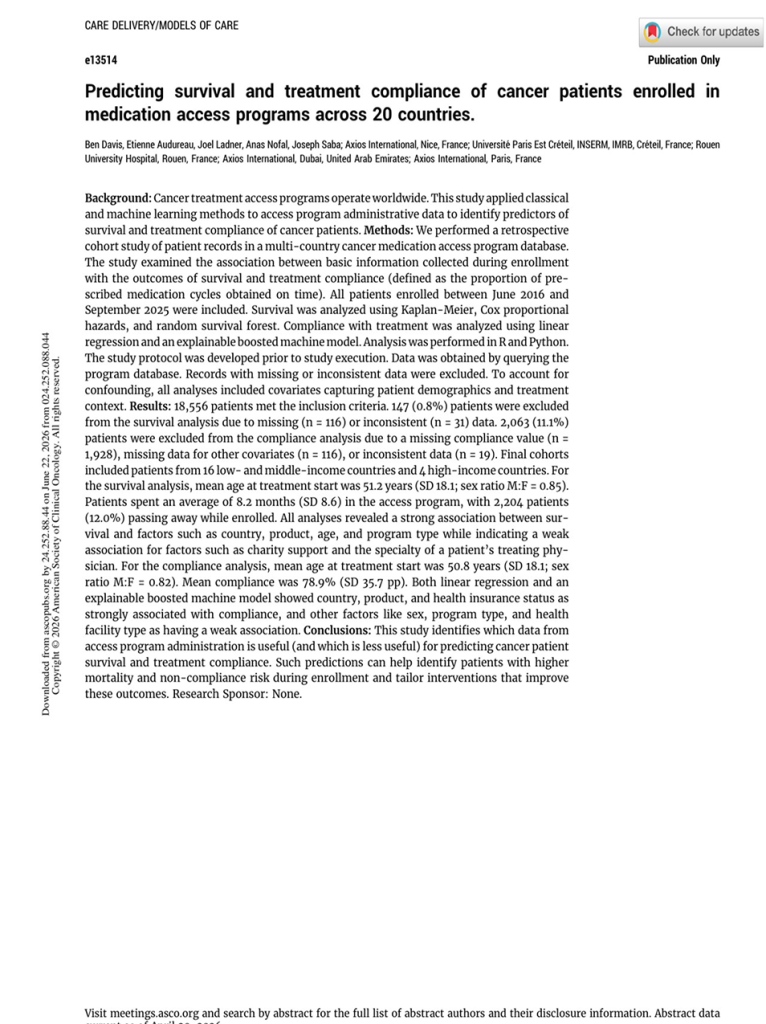

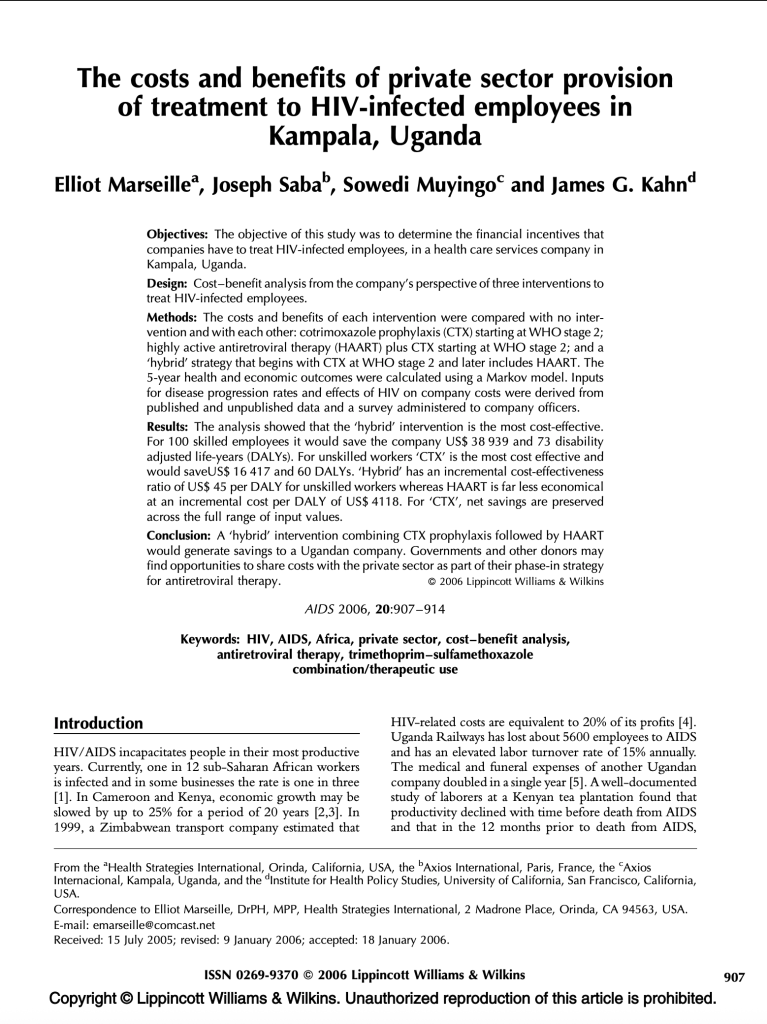
This study examined whether Ugandan companies could save money by providing HIV treatment to their employees, using detailed financial and health data from a Kampala-based health services company. Researchers compared three treatment approaches — a low-cost preventive antibiotic (cotrimoxazole), full antiretroviral therapy, and a “hybrid” approach that starts with the preventive antibiotic and adds antiretroviral therapy as illness progresses — against providing no ongoing treatment, tracking costs and health outcomes over five years.
Publication
The Costs and Benefits of Private Sector Provision of Treatment to HIV-Infected Employees in Kampala, Uganda
Marseille E, Saba J, Muyingo S, & Kahn J.
AIDS
Published
Key Takeaways
This study examined whether Ugandan companies could save money by providing HIV treatment to their employees, using detailed financial and health data from a Kampala-based health services company. Researchers compared three treatment approaches — a low-cost preventive antibiotic (cotrimoxazole), full antiretroviral therapy, and a “hybrid” approach that starts with the preventive antibiotic and adds antiretroviral therapy as illness progresses — against providing no ongoing treatment, tracking costs and health outcomes over five years.
- The “hybrid” treatment approach was the most cost-effective option for higher-wage (skilled) employees, saving the company over $38,000 while also producing significantly better health outcomes than the antibiotic-only approach.
- For lower-wage (unskilled) employees, the antibiotic-only approach delivered the greatest direct savings, while the hybrid approach still offered strong value for a modest added cost.
- Full antiretroviral therapy improved health outcomes the most but was the least cost-effective option for the employer under the study’s five-year time frame.
- The findings suggest that some businesses in sub-Saharan Africa have a genuine financial incentive, not just a moral one, to treat HIV-positive employees, pointing to opportunities for governments and donors to partner with the private sector in expanding treatment access.
Resources
Recent Publications