
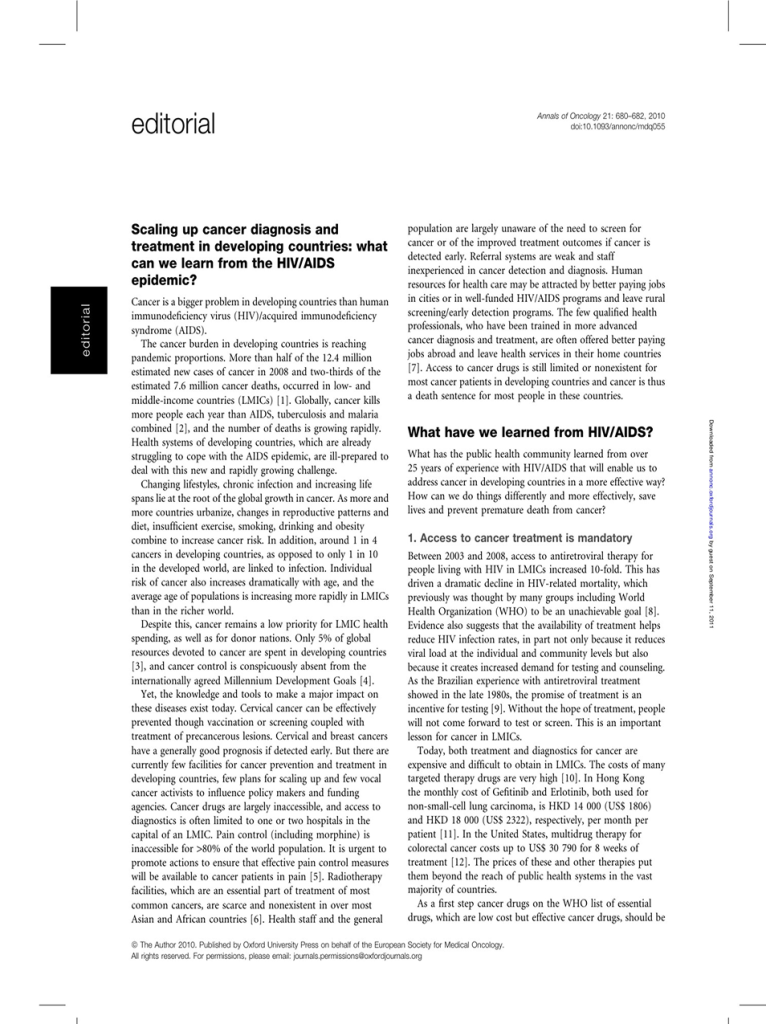
This editorial argues that cancer, not HIV/AIDS, is now the bigger health threat facing developing countries, killing more people worldwide each year than AIDS, tuberculosis, and malaria combined, while receiving only a fraction of global health funding and attention. Drawing on lessons from three decades of the AIDS response, the authors lay out a three-part roadmap, guaranteeing access to treatment, integrating cancer care into existing health systems, and driving advocacy and public education, for how developing countries can begin closing the cancer care gap.
Publication
Scaling Up Cancer Diagnosis and Treatment in Developing Countries: What Can We Learn from the HIV/AIDS Epidemic?
CanTreat International
Annals of Oncology
Published
Key Takeaways
This editorial argues that cancer, not HIV/AIDS, is now the bigger health threat facing developing countries, killing more people worldwide each year than AIDS, tuberculosis, and malaria combined, while receiving only a fraction of global health funding and attention. Drawing on lessons from three decades of the AIDS response, the authors lay out a three-part roadmap, guaranteeing access to treatment, integrating cancer care into existing health systems, and driving advocacy and public education, for how developing countries can begin closing the cancer care gap.
- More than half of the world’s new cancer cases and two-thirds of cancer deaths occur in low- and middle-income countries, yet only 5% of global cancer resources are spent there, and cancer was left out of the Millennium Development Goals entirely.
- The AIDS response proved that rapid scale-up works: access to antiretroviral therapy increased tenfold between 2003 and 2008, and the paper argues cancer treatment needs the same urgency, since the hope of treatment is often what drives people to get screened in the first place.
- Low-cost, low-tech solutions already exist and work at scale: nurse-administered visual screening and cryotherapy for cervical cancer, and a Malaysian public-awareness campaign that cut late-stage breast cancer diagnoses from 77% to 37% through community education and staff training.
- Pain relief is a widespread crisis on its own, with effective pain control inaccessible to more than 80% of the world’s population, and the paper calls for greater investment, national health system integration, and stronger advocacy to bring cancer care to scale globally.
Resources
Recent Publications