
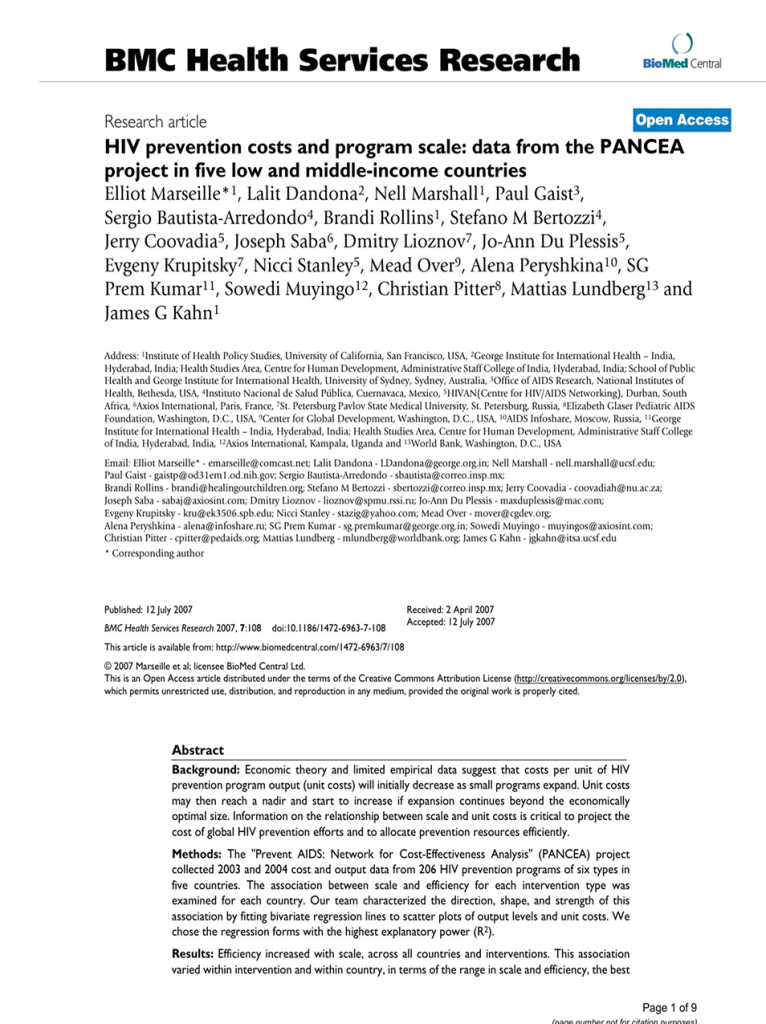
This study analyzed cost and output data from over 200 HIV prevention programs across India, Mexico, Russia, South Africa, and Uganda to answer a basic but important question: does it get cheaper, per person served, to run an HIV prevention program as it grows bigger? The answer was yes almost everywhere the researchers looked, a finding with major implications for how donors and governments should plan and fund the global scale-up of HIV prevention efforts.
Publication
HIV Prevention Costs and Program Scale: Data from the PANCEA Project in Five Low- and Middle-Income Countries
Saba J, Muyingo S, et al.
BMS Health Services Research
Published
Key Takeaways
This study analyzed cost and output data from over 200 HIV prevention programs across India, Mexico, Russia, South Africa, and Uganda to answer a basic but important question: does it get cheaper, per person served, to run an HIV prevention program as it grows bigger? The answer was yes almost everywhere the researchers looked, a finding with major implications for how donors and governments should plan and fund the global scale-up of HIV prevention efforts.
- Across nearly every country and program type studied (counseling and testing, sex worker outreach, treatment for sexually transmitted infections, media campaigns, needle exchange, and mother-to-child transmission prevention), larger programs consistently cost less per person served than smaller ones.
- On average, doubling the size of a program cut its cost per person served by about a third, though the size of that saving varied widely, from as little as 2% in some countries to well over 50% in others.
- Only two of the fifteen country-and-program combinations studied showed costs eventually rising again after a certain size, suggesting that most programs examined hadn’t yet hit a point of “too big” inefficiency, encouraging news for global scale-up efforts.
- The study found no meaningful link between program quality and cost, meaning bigger, cheaper-per-person programs weren’t simply cutting corners; the savings likely come from spreading fixed costs over more people served and staff getting more efficient with experience.
Resources
Recent Publications