
This study compared school attendance and grade delay between AIDS orphans and non-orphans in three low-income communities in Tanzania and Burkina Faso, testing the common assumption that losing parents to AIDS puts children at a distinct educational disadvantage. While orphans were initially more likely to be out of school or behind in their studies, that gap largely disappeared once the researchers accounted for other factors like age, religion, family background, and household composition.
Publication
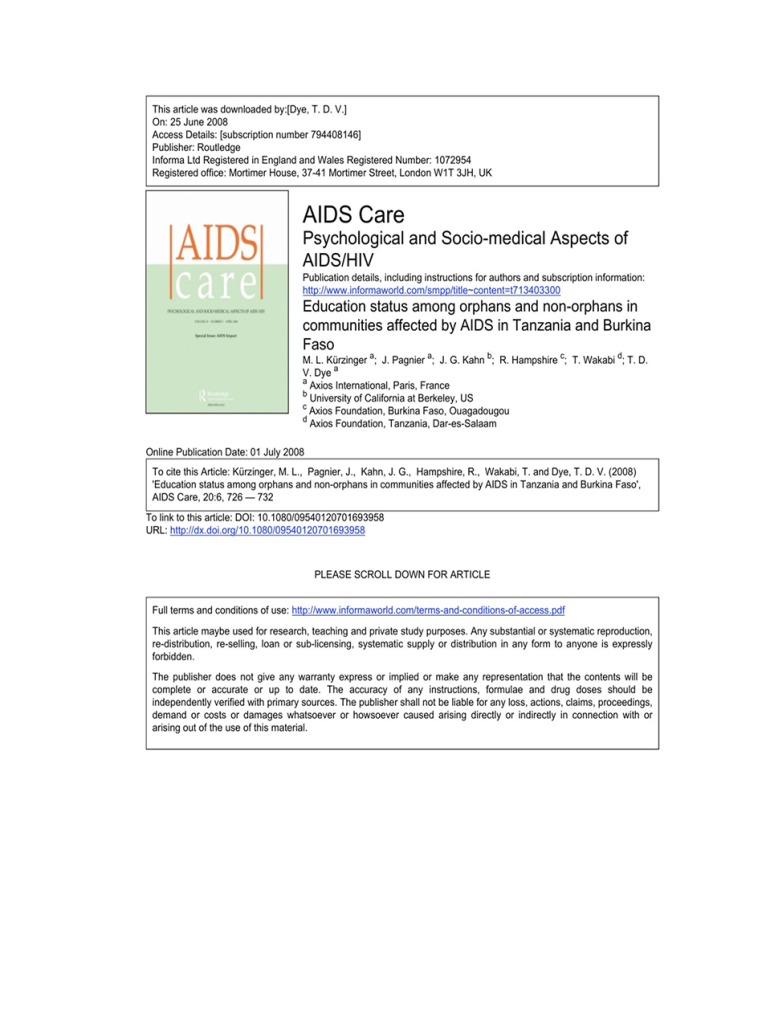
Education Status among Orphans and Non-Orphans in Communities Affected by AIDS in Tanzania and Burkina Faso
Kürzinger M, Pagnier J, Kahn J, Hampshire R, Wakabi T, & Dye TD.
IDS Care
Published
Key Takeaways
This study compared school attendance and grade delay between AIDS orphans and non-orphans in three low-income communities in Tanzania and Burkina Faso, testing the common assumption that losing parents to AIDS puts children at a distinct educational disadvantage. While orphans were initially more likely to be out of school or behind in their studies, that gap largely disappeared once the researchers accounted for other factors like age, religion, family background, and household composition.
- On the surface, orphans were significantly less likely to attend school and more likely to be delayed in their studies compared to non-orphans.
- Once other household and family factors were accounted for, orphan status itself was only a borderline, not statistically significant, predictor of poor educational outcomes.
- Factors like a child’s relationship to the head of their household and the number of dependents relative to working-age adults in the home explained the differences in education better than whether a child was orphaned.
- The findings suggest that family- and community-based safety nets in these AIDS-affected communities may be effectively cushioning orphaned children, helping keep their educational outcomes roughly on par with their peers, an encouraging sign for how communities can respond to the orphan crisis without necessarily needing orphan-specific interventions.
Resources
Recent Publications