
This study analyzed data from over 280,000 pregnant women across 269 clinical sites in 15 sub-Saharan African countries to understand why some HIV prevention programs reached far more eligible mothers than others. The analysis found that broader national context, like public awareness and healthcare investment, mattered more than local site-level factors in explaining why some programs succeeded and others struggled.
Publication
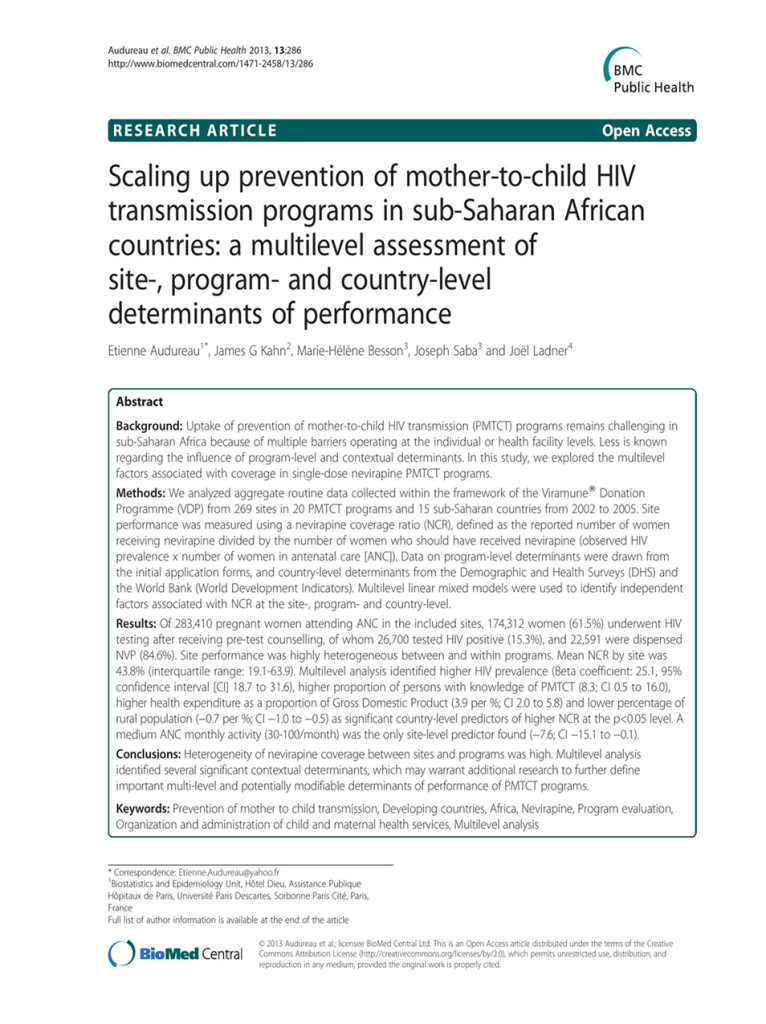
Scaling Up Prevention of Mother-to-Child HIV Transmission Programs in Sub-Saharan African Countries: A Multilevel Assessment of Site-, Program-, and Country-Level Determinants of Performance
Audureau E, Kahn J, Besson MH, Saba J, & Ladner J.
BMC Public Health
Published
Key Takeaways
This study analyzed data from over 280,000 pregnant women across 269 clinical sites in 15 sub-Saharan African countries to understand why some HIV prevention programs reached far more eligible mothers than others. The analysis found that broader national context, like public awareness and healthcare investment, mattered more than local site-level factors in explaining why some programs succeeded and others struggled.
- On average, only about 44% of women who should have received the HIV-prevention drug actually did, with huge variation between sites and countries, ranging from essentially 0% to full coverage.
- Countries where more people had specific knowledge about mother-to-child HIV prevention, and where governments spent more on healthcare relative to their economy, saw meaningfully higher coverage.
- Coverage was lower in countries with larger rural populations, pointing to the ongoing challenge of reaching remote communities.
- Reinforces that expanding access to medicine isn’t only about the drug supply chain. National-level investment in healthcare and public education plays an outsized role in whether life-saving programs actually reach the people who need them.
Resources
Recent Publications